Friday, May 16, 2014

Book Review: Poor but spirited in Karimnagar; Field notes of a Civil Servant


As a guy who is from Karimnagar, and who witnessed Smt. Sumita Dawra's administration first hand. i wanted to read this book since it was published. There are a few things which persuaded me to read this. As an aspiring civil servant, i wanted to gain experience to become better acquainted with grass root level administrative process, and there is no best way than to learn it from my childhood role model.

I firstly bow down to the commitment of all the sincere civil servants like Smt. Sumita Dawra, who have dedicated their lives to make things better. This book has gained my respect for its pragmatic approach and for the experiences author has shared. Though I do have some ideological differences with some of author's  points, there are a lot of things I would appreciate. I should say that this book is a compelling read for people who want to know real India. All this humdrum about politics has made me think how people are "Educated illiterates", including me! how much of what we discuss and debate is futile and how there are people right now, burning midnight oil for a better India.

Coming to the book, It might not the best book for policy making, but i can assure you that this book has a lot of merit in connecting dots between policy making and reality. A benevolent administrator meets, macro level policy making through her experience as well as case studies, summarizes this book in a single line.

Book has eight chapters, every chapter has three sections - identifying the problem, providing the context and the author's solutions for those problem. The book starts with an introduction of Wicked problems. how the fields of poverty alleviation, education, health care, agriculture, water and sanitation and urban governance, are stuck in wicked issues. How solutions based on greater community involvement, decentralisation  of administration, innovation, feedback mechanisms, proper accountability and an able leader can change the fabric of stagnant country.

The narration of experience of author as an administrator are inspiring and moving simultaneously. Especially in the chapter three, Epidemic and Malnourishment in Karimnagar, author's recollections, reminded me of why I wanted to prepare for civil services. This chapter shows how different sections of society live different realities.

Finally I would definitely recommend this book to people who are preparing for civil services and other people in general. I am giving links to buy the book. If you have any personal thoughts please drop them in comments. I will try to review more books, which I find interesting as well as important.

Thank you,
Shiva


http://www.thehindu.com/todays-paper/tp-national/senior-ias-officer-sumitra-dawra-pens-a-collectors-copy/article3732494.ece
Flipkart:
http://www.flipkart.com/poor-spirited-karimnagar-field-notes-civil-servant/p/itmddt4qbperntb7
Amazon:
http://www.amazon.in/Poor-But-Spirited-Karimnagar-Servant/dp/9350291509

Monday, May 5, 2014

Authoritarian party and Democracy: Criticism of party politics in India I

People often think that they only have choice between bad and worse in the elections. Hence in the group of bad, they vote for least bad. hence end up in 5 years of rut!

Our two time Prime Minister came from upper house, Rajya Sabha. Why do you think, he never competed for Lok Sabha seat in last 2 terms? is it because the party as well as he did not have confidence in people's capability to elect a wise man? Do you think the he/party kept him away from elections to protect his  integrity? Do you think the quality of leaders elected through through direct elections  do not meet the requirement of people? Is there a gap between what people choose and what people's requirement is? If there is a gap, who decides what the peoples requirements are and who( Prime minister in this case) should be selected to meet them?  Who gave power to party to do all this?

All the above questions point towards the level of autonomy a party has in our political system. In a vast country like India, perfect democracy is not possible. It needs to provide a considerable amount of autonomy to various institutions. Autonomy means power, as Lord Acton quoted "Power tends to corrupt and absolute power corrupts absolutely." This corruption has directly or indirectly lead Authoritarian Party system. Let us understand its development in historical perspective. 

To understand the development of Authoritarian party system, we need to first understand even basic conflict which persisted since Independence. Should elected government be accountable to people or party? this debate resulted in ambiguity which provided a path to the current form of party system.

Leadership of party versus Government

Pre-independence era

This era was marked with party democracy at all levels of the cadre, critical decisions were taken based on majority consensus, every idea was discussed among the members of the party. This can be examined through examples of Constituent assembly though being a one-party body, took everyone's ideas and criticism into account while making constitution, It even included non party members like B.R.Ambedkar. Similarly, the decision to start Non-Co-operation movement was taken with 1336 votes for and 886 votes against Gandhiji's resolution. During Second World War, Gandhiji's stand on cooperation with the war effort was rejected by Congress. 

Nehru era

As Congress was the only major party which dealt with this problem in the initial years of Independence, lets discuss about it. In November 1946, Jawaharlal Nehru resigned from party presidentship, and joined the interim government on the grounds that the roles of leader of a party and leader of government could not be combined. His successor J.B.Kriplani, however demanded a greater role for Congress Working Committee(CWC) a larger role in the working of the government, and all the government planning should be taken in consultation with them.
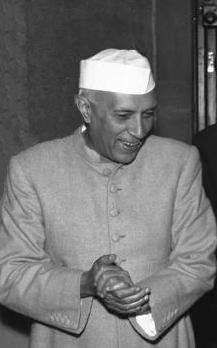
Jawaharlal Nehru
Nehru, Sardar Patel and other prominent leaders did not agree to it. They argued that proceedings of Government are secret and cannot be divulged to party. They argued that, party should give ideological direction in long term policies and goals but should not interfere in governance. Eventually J.B.Kriplani resigned from the office. In 1950, another conflict broke out between Right wing conservative Purushottom Das Tandon and Nehru because of difference in ideology and former being elected as Congress president. Nehru, who couldn't imagine right wing outlook prevailing over upcoming government, threatened with his resignation to get Tandon out of presidentship, there was an other conflict between them which remained unresolved until now, that is party's control over elected government. The two conflicts above show how Nehru analysed the varying degree of acceptability of party's intrusion into governments functioning. After demise of Gandhi and Patel, though Nehru was the sole strong leader in congress, he didn't let authoritative tendencies take over him, he respected everyone's opinion.  I believe that Nehru's threatening for tandon's resignation is the first step of party's transition from democratic towards authoritarian structure, even then democratic tendency of party survived  until Nehru's demise in may 1964.

Post Nehru era: Shastri, Indira and Syndicate

Lal Bahadur Shastri
Nehru in his final fearing degeneration of party democracy because all the cabinet ministers were forming aristocracy and loosing roots in public, with K.Kamraj, came up with a plan which came to be known as Kamraj plan. It was supposed to make six cabinet minters and others to resign and join party cadres for its revival. Unfortunately Nehru died before he could come up with new cabinet. Even then Nehru was so confident in party's democracy that he didn't announce a successor. K.Kamraj, became the next part president, he formed the syndicate. Syndicate was a strong sub group inside Congress. They made Lal Bahadur Shastri the new PM of India. Initially, he was completely under control of syndicate but after sometime he asserted his power in Indo-Pak war of 1965.

Article to be continued 

Democratization of internet


The following article is from economic and political weekly,  and has been produced here for non commercial purposes.

Whither Internet Democratisation?
The "NETmundial" conference in Brazil on democratising internet governance was a vacuous exercise.

The internet today is ubiquitous the world over as a mode of communication and diffusion of knowledge, and an arena for commercial business, among other things. Its massive expansion, largely in a free and equitable manner, has much to do with the effort of various communities of people engaged in building a digital commons over and beyond the pioneering efforts of departments of the US government that built the internet in the first place. Issues of governance have inevitably come to the fore, and much was expected from the conference, “NETmundial”, held last month, which sought to build upon prevailing ideas concerning multilateralisation of internet governance.

At present, it is the agencies of the US government that control the nuts and bolts of internet architecture, primarily the domain name system (DNS) and the root zone server which controls the naming and addressing protocols for domains all over the world. The US government has over the previous decade and a half resolved to loosen its hold – through the aegis of US commerce department’s National Telecommunications and Information Administration (NTIA) – over the DNS and the root zone server. The work of maintaining the two have been contracted to the not-for-profit Internet Corporation for Assigned Names and Numbers (ICANN), headquartered in the US. On 14 March 2014, the US government reiterated its intent to undertake the transition to – what it has called – a “multi-stakeholder model” of internet governance.

Previously, the “multi-stakeholder model” was shorthand for privatisation, basically leading to corporate control over the internet’s key resources, but over time it has intended to include various civil society representatives and organisations. In its present intended configuration the model is now pitted against what others have argued for – a “multilateral model of governance”. The latter has pitched for a UN-like grouping of nation states having a say in internet governance through a multilateral international organisation.

The US, with support from many of its OECD (Organisation for Economic Co-operation and Development) allies, has steadfastly refused to allow a transition of this kind, fearing loss of inherent control of national law and national government agency regulation of the internet. This has led to grievances over the US’s retention of the internet’s major governing resources. Since last year, it has been clear that the US government along with large and predominantly monopolist internet corporations have conducted mass surveillance over the internet of people even beyond the US’s borders. The US government has also declined to curb the anti-competitive practices of the monopolistic corporations command­ing various aspects of the internet. It has pushed the veneer of protection of civil liberties guaranteed in its Constitution and its purported role as the leader of the “free world” in refusing to cede any ground to proposals related to multilateral governance of the internet. A multilateral approach has been deemed necessary by many as it is well understood that sovereign nations have the best wherewithal to address issues such as cyber warfare/cyber-terrorism or to bring into place restrictions on unfair practices that establish monopolistic control over the internet’s resources.

It is in this regard that Brazil among others has initiated a dialogue between those advocating a “multi-stakeholder approach” and those for a “multilateral approach” to internet governance. “NETmundial” was intended as a step in this direction. It sought to build upon the ideas for multilateralisation of internet governance as these have evolved from the Tunis agenda for the Information Society conducted by the World Summit on the Information Society in 2005. The conference was held in the context of Brazil’s move to counteract US domination over internet resources, which had made possible Washington’s “boundless” and intrusive surveillance programmes. It coincided with the signing into law by Brazil’s Parliament of a bill of internet rights that protects the civil liberties of internet users in the country. This law includes the provision of “net neutrality”, a principle that equalises access to any website for the ordinary user. It is noteworthy that a US federal court had in January this year ruled against “net neutrality” in favour of a communication services corporation. In this context, it is worrying that articulation of the need to preserve “net neutrality” was expressly lacking in the outcome document of the conference’s deliberations.

While the outcome of the conference was a “non-binding” set of principles, efforts to reach a workable consensus that protects the “free-ness and openness” of the internet and permits democratic “multi-stakeholder” control over the internet’s governance system were only partially successful. With continued scepticism emanating from the US and its allies over the need for other states to participate in the transition to a multi-stakeholder model, the use of language favouring strict copyright laws and inter­mediary liabilities amounting to decentralised policing by intermediaries over users, the outcome document has belied expectations. The US continues to remain non-committal about how it seeks to implement its intent of bestowing internet governance upon a global community of multiple stakeholders. Without a discriminating and discerning differentiation of roles and responsibilities between stakeholders such as global corporations, civil society organisations and sovereign nation states, and allowing for a more decentralised structure of internet Governance,  the proposed transition accounts to a vacuous exercise.  

Wednesday, January 15, 2014

Issues of contemporary India: Environmental degradation-I

I already wrote a small article about soil degradation and Desertification. you can check it out at http://upsctarget.blogspot.in/2014/01/issues-of-contemporary-india.html

Environment or nature is everything that surrounds us. The traditional egocentric approach towards usage of resources has degraded environment to such a level that the plush green forests, which come into our mind when we think of nature do not exist anymore. Environment or nature, what is left of it is among us. We use it every day, for paper, for electricity, our clothes and most of all the basic requirements for our mere existence air, water and food. Every economic structure is based on concept of limited resources and their distribution, but no one care about who is giving those resources. Our nature has a unique ability to recycle certain resources, some are manually recycled and replenished and some are completely exhausted without replacement. hence hampering the natural balance.

Some of the effects of human activity are completely irreversible, because of us many species of plants and animals have been extinct and many more on the verge of extinction. But why should we even care if some species are extinct and the environment we live in is changing(degrading)? If we do care, are we even responsible for it, or is it just the phase of earth's evolution? What is causing it? how can we stop it? What has been done to stop it? what needs to be done are some of the questions faced by people all over the world.

Why should we care?. let us look at Biological cycles like carbon cycle, water cycle, nitrogen cycle and phosphorous cycle. All have one thing in common, they are in harmony, and they have a certain amount of tolerance towards any change. But beyond the tolerance level, the cycles collapse and cause problems to our  very existence. Now are we responsible for it? recently there have been a lot of news about global warming, melting of ice caps and other environmental effects, but are we even responsible for them, or is it just a part of earth's hot and cold cycles. A lot of theories popped up which do suggest that some of it might be earth's transitional effect. But most of the effects are man made, since we are responsible for causing damage to the source of our existence. We need to take up responsibility to stop and undo some of the damage we have caused. "We need to protect the environment so that it can give us protection".

Environmental protection does not just mean, bunch of activists going and hugging a tree in forest to save it. It starts in every house hold with each and every action.  We need to reconsider everything we use in our daily life, consumerism, as such is at question here. The capitalist attitude to promote consumption, people's desire to have more and more babies all are at question. When our existence is at stake especially because of our existence, there is something  inherently wrong and suicidal. There is no limit to our imagination but there is a limit to resources and any over exploitation of these resources is detrimental.

I remember as a kid, I used to believe that everything is possible. I used to think that if i had will and imagination I could be a superhero, maybe I would have like batman at the cost of my body, and perish. With age I understood that there are limits which i cannot break or i should not break. I'm not saying that the youthful me was wrong in any sense, I just say with maturity I understood the tenets of survival. Apply the same to entire human beings, we aspire to defy the laws of nature, we like to get fat while riding our super fast cars, not that there is anything wrong in it (especially when I myself am getting fat) but maybe we as a whole need to understand our surroundings better and start living better.

Next blog I will get into, the ideas which circulate in academic circles to understand the tenets of our survival, some of which came into light. What are organisational efforts taken by India and other International organisations.

Thank you
Shiva :)

Monday, January 13, 2014

Contemporary issues of India: Gender Discrimination-I


Each and everyone of us is a perpetrator of gender discrimination. I, like everyone else was blinded by misogyny and patriarchy inherent in our society.  I'm appalled by the systemic discrimination our society accommodates when finally the dense fog has lifted over my eyes.  We have been victims of desensitization and aloofness about gender discrimination.

Lets understand this by some examples with some News headlines,

Gurgaon Police had ordered not to employ women after 8 pm, if they do, then they need to give security.

Engineering college has made it mandatory for girl students to wear decent dresses

Haryana MLA says revealing dresses and pub culture are responsible for rise in crimes against women

Sena storms into pubs hits women, alleges cultural drain

Shoot daughter if she elopes- UP top cops advice

Youth attacks a minor girl with acid for rejecting him

Wife goes to court for alleged violence in marriage

IIT graduate expects gift(dowry) of one crore

How many of you think all of them or at least one of them is right news?
Did any of the news irk you?

As a matter of fact all the news presented here is covering sexism in society to varying extents. If you think at least one of the above news is legitimate, you are inherently a perpetrator of sexism. If we look at the general statistics, 

  • The Adult sex ratio since independence to 2001 has dropped to 933/1000 and has marginally increased to 940/1000 in 2011. 
  • Child sex ratio is even worse which has been dropping continuously and is lowest since independence at 914/1000 in 2011. 
  • Only 3% of women are employed in higher managerial jobs.
  • 20% technical and non technical jobs with 25% share in income.
  • 10-12% parliament representation. 


All of the above are just few illustrations of permeating discrimination against women in society.Now a lot of people might ask what is the harm in Gurgaon making a law for protection of women from predators? to answer that question, we need to first answer certain implicit questions like, where did these predators come from? Why do we have a higher rape aggregate in India? Is stopping companies from employing women after 8 pm the right way to stop crimes against women? Who is responsible for rise of crimes against women? Is it rapid westernization or the culture of mini skirts or simply the perpetrators of these crimes against women? Who is really contributing to the rise in crime against women? 

let us first analyse some structural problems in our society.

Protectionism Vs Empowerment

Quite often in Indian context, people see no difference between both. Government of India and its laws like Dowry prohibition Act(1961), Protection of women from domestic violence act(2005), The Muslim women Protection of Rights on Dowry Act 1986, termination of pregnancy act 1976 and a lot more focus mainly about protection than empowerment. If we ask an average father what he would do to keep their daughter safe...you might hear a few of the following responses.

a) Stop the daughter from going out late night
b) Make her learn self defense
c) Raise voice against government for its inability to provide security

Some of these responses are more common than the other. Both, the responses a and c are protectionist whereas option b is empowering. If we see the Gurgaon's case, gives the same impression. Instead of making society conscious about their inherent gender bias, they chose to degenerate status of woman further, making them a commodity which needs protection than empowerment!

In a patriarchal society like India, everyone who takes lead role in a family from fathers, brothers, husbands to the government, everyone prefers protectionism as opposed to empowerment, consciously or sub-consciously to meet their ends(although male lead role itself is a form of discrimination, we will get to that later!)while giving their boy child every possible opportunity to develop and grow into an individual adult. A woman on the other hand is traded like a precious ornament which needs to be safeguarded, from one hand to other. What difference does a girl see between an ancient society and a modern one when very little has changed in perception of woman as property as opposed to an individual?

Further reading in coming blogs

Yours
Shiva :)


Saturday, January 11, 2014

Issues of contemporary India: Desertification

These days everyone seems to be interested in making the world a better place. They want better governance, better utilisation of resources. They want to make Government and other organizations to take reponsibilty. But I'm going to ask one question, How many of us are ready to accept responsibility and do something for a better world?. Its easy to blame others for what is happening, it is hard to own responsibility and do something about it. I'm going to write a series of blogs on different issues destroying contemporary India.

Desertification

The defiinition in Wikipedia is
"Desertification is a type of land degradation in which a relatively dry land region becomes increasingly arid, typically losing its bodies of water as well as vegetation and wildlife. It is caused by a variety of factors, such as climate change and human activities. Desertification is a significant global ecological and environmental problem."

Now, I know most of the people who are reading this are unaware of the fact that 1/3rd of all the land in India is at a verge of Desertification. No one seems to care about it, though it is as important as climate change and whose effects are immediate and drastic. A report submitted to the United Nations Convention to Combat Desertification (UNCCD) by the Environment Ministry in fourth week of April 2013 described that one third of India’s geographical area is undergoing the process of desertification despite of the efforts made by it to combat the problem. But  what are the effects of desertification? is it really serious? whose responsibility is it anyway? what is causing it? What can we do to stop it?, these are some questions we are facing today. 

India's growing population and dire need for food production to meet the population, exerts an enormous pressure on land. The socio-economic and cultural effects of desertification are disastrous.With 60% of the population depending on land for income directly or indirectly, it would be of huge economic consequence. Social effects like unrest, poverty and cultural effects like migration may be of dire consequences. So desertification needs our immediate attention. 

Out of India's 328 mha total area nearly 69% of our land area is arid, semi-arid or dry sub-humid. A moajor part of these areas is prone to desertification. In report to UNCCD, MoEF has analysed land usage pattern in India with the help of ISRO concluded that 106 mha i.e 1/3rd of area is undergoing desertification. 

The causes of desertification are vegetal degradation, water erosion, wind erosion, wind/eolian degradation, frost shattering, salinity/alkalinity, mass movement, water logging, rocky areas/barren land, man made, frost heaving and others. 
      Process wise distribution of the area under land-degradation for India
Lets look at the causes one by one. 
Vegetal degradation: it is observed mainly as deforestation/ forest-blanks/ shifting cultivation and degradation in grassland/grazing and scrubland. This happens in both warm and cold areas. 
Water erosion: Sheet erosion/rill network/ shallow gully erosion fall mainly under this category. It comprises mainly of agricultural land. 
Wind erosion: mainly happens in the close proximity of deserts mainly because of lift and drift effect of wind
Salinization/ Alkalinization: Mainly in cultivated lands because of excess ground water usage, soil erosion, usage of different insecticides and pesticides. 
Water wasting:  happens due to rock, regolith and debris movement down hill due to land slides, creeping. 
Man made: though most of the above causes are indirect effects of man made causes. There are a few direct causes like Mining, brick kiln, industrial effluents, city waste and others

Desertification map of India

If we see above pattern, almost all the causes of desertification are man made directly or indirectly. Indirect causes like global warming, deforestation, unregulated cattle grazing, excessive usage of pesticides and insecticides, over exhaustion of ground water and many others, while making a mess directly by mining, industrial  effluents, city waste, improper drainage and others. There is no easy solution for stopping desertification, the first step towards it should be efficient utilization of resources by every individual, economic usage of ground water, awareness of renewable and bio-degradable sources of consumption and others. It would be hypocritical of us, if we just accuse the Government and others of not maintaining India in perfect health, when we the people are causing the problems and not doing anything about it.

regards,
Shiva :)

Reference

Tuesday, November 5, 2013

Understanding India's border disputes Part I: India & China

India's historic and geographical contexts are very important when we look into India's border disputes with its neighbouring countries. India was under the British control for two centuries. Before Independence, British territory was divided into different Presidencies and Provinces, with independence also came India-Pakistan bifurcation. Almost all the borders were redrawn just before and after Indian independence. Despite sincere efforts British could not mediate all the boundary issues and they were passed on to Independent India.

British Indian Empire 1909 Imperial Gazetteer of India
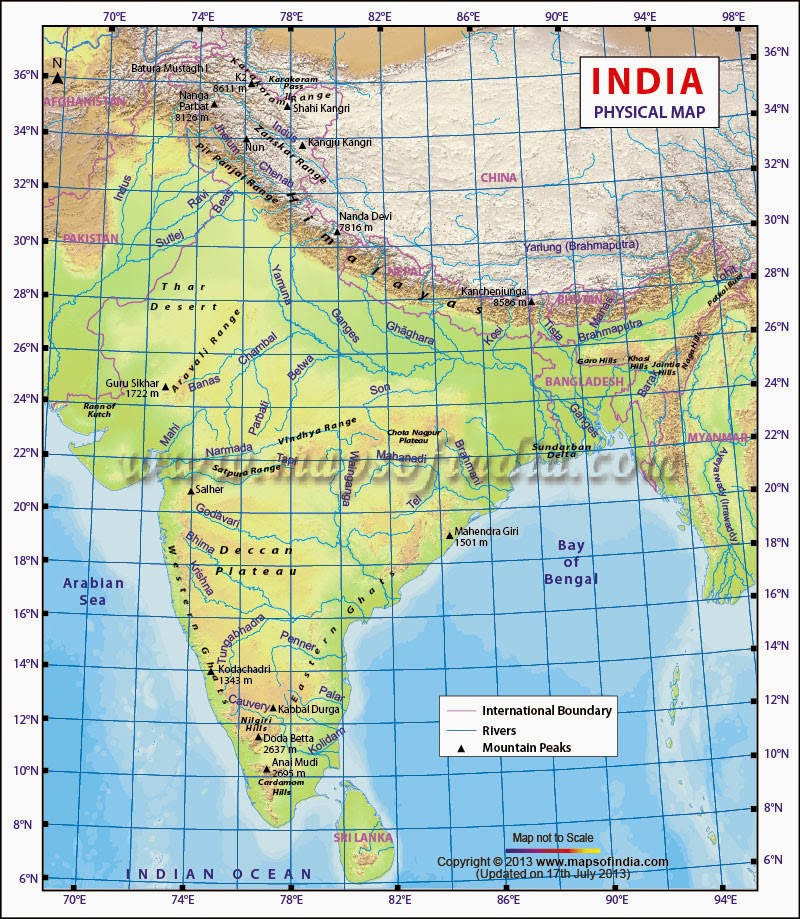
Currently, India is part of South Asia. The northern frontiers of India are defined largely by the Himalayan mountain range, where the country borders China, Bhutan, and Nepal. Its western border with Pakistan lies in the Punjab Plain and the Thar Desert. In the far northeast, the Chin Hills and Kachin Hills, deeply forested mountainous regions, separate India from Burma. On the east, its border with Bangladesh is largely defined by the Khasi Hills and Mizo Hills, and the watershed region of the Indo-Gangetic Plain.
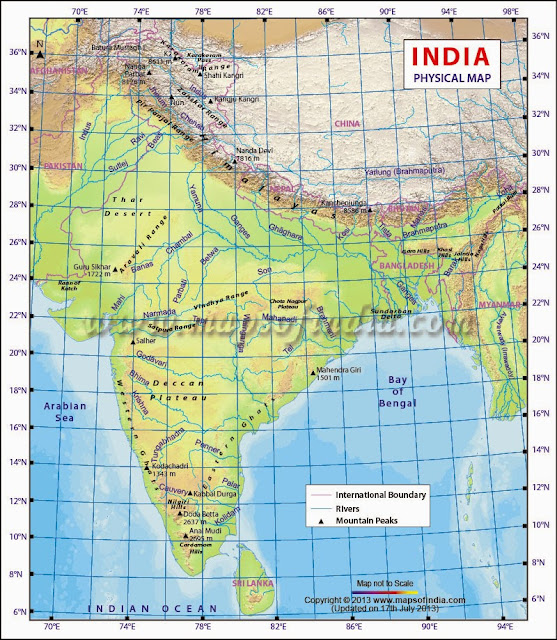


India Physical Map 

lets take up border disputes and their related issues country wise.

India & China

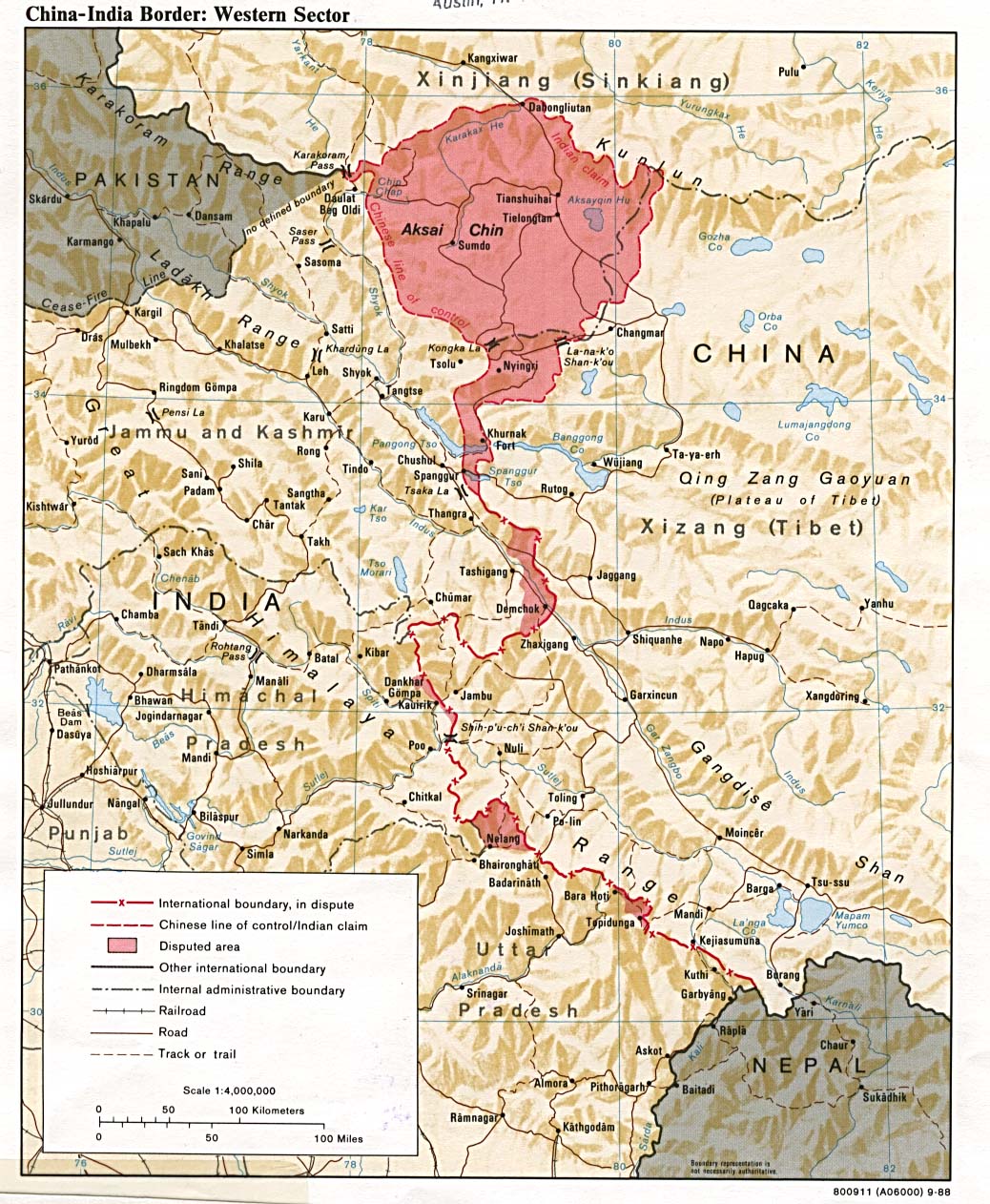
India- China Western Border and disputed area

 
The boundary issue between India and China are mainly because of two areas. One lies in the north eastern part of former princely state of Kashmir. It is now either in Indian province of Kashmir or in Xinjiang province of China. It is uninhabited wasteland crossed by Xinjiang-Tibet highway. The other boundary in dispute is between Arunachal Pradesh of India and South of Tibet.It is sparsely inhabited with numerous local tribes.

Understanding Aksai Chin dispute

Aksai Chin is North-Eastern part of Kashmir. Sikh confederacy of Punjab had annexed Ladhakh into state of Kashmir in 1934. In 1941 they invaded Tibet, Chinese forces defeated and inturn entered Ladhakh and besieged Leh. After being checked by Sikh forces Chinese and Sikh forces signed an a treaty in 1842, which stipulated no transgressions or interference in the other countries frontiers. After british victory over Sikhs, the British have attempted to meet with Chinese officials to discuss the border. However, both sides were sufficently satisfied that traditional border was recognised and defined and border was never demarcated. the boundaries at the two extremeties, Pangong Lake and karakoram pass were well defined but the Aksai Chin area lay undefined.   

The Johnson Line

W.H. Johnson, a civil servant with survey of India proposed the "Johnson Line" in 1865, which put Aksai Chin area in Kashmir. During this time Aksai chin was bordering Turkestan and hence Chinese were never presented this boundary line. Later Chinese reconquered Turkestan. British had doubts about this line and has been censured. In 1897 a British Military officer, Sir John Ardagh argued that this line was more defensible and later this line came to be known as "Johnson-Ardagh line".

The Macartney-Macdonald Line

In 1890 British and China were allies angainst Russian threat to Aksai chin. Chinese showed interest in Aksai Chin and Britain proposed revised boundary suggested by George Macartney which put most of the Aksai Chin in Chinese territory. The British presented this line to Chinese in a note by Sir Claude Macdonald. The Chinese never ratified this and British took this as Chinese acquiescence. This line is knows as "Macartney-Macdonald line", its approximately along Line of Actual Control.
Both The lines were used in British maps of India later.

Since 1947

Upon independence in 1947, the government of India used the Johnson line as the basis for official boundary in the west. The Chinese argued that the western border has never been delimited, that the Macartney-Macdonald line is the only line which was ever proposed to Chinese government. Chinese government also argues that Aksai Chin is already under the Chinese Jurisdiction, and the negotiations should take into account the status quo. During 1950s, Chinese Government built a road connecting Xinjiang and Western Tibet, which runs 179 km south of Johnson line.
the Indian position, as stated by Prime Minister Jawaharlal Nehru, was that the Aksai Chin was "part of the ladhak region for centuries" and this border is "firm and definite one which was not open to discussion with anybody"

Trans Karakoram Tract

The Johnson line was not used to the west of Karakoram tract, where Pakistan-administered Gilgit-Balistan. In 1962, China and Pakistan began negotiations over boundary in the west of Karakoram pass. In 1963 they settled the boundary largely on the basis of Macartney-Macdonald line. This agreement provides renegotiation in case of settlement of Kashmir dispute. India does not recognise Pakistan and China have a common border. However, India's claim line in that area does not extend as north as Johnson line beyond karakoram tract.

The McMohan Line

India-China Eastern border
British India and China gained a common border after British annexation of Assam in 1826 and also after Anglo-Burmese war(1824-1826).
In 1914, Offical representatives from Britain, tibet and China met in Shimla and drew up an agreement regarding Tibet's borders. the Macmohan line which demarcates boundary between India and Tibet in eastern sector was drawn by Henry Macmohan on a map attached to the agreement. China immediately repudiated the agreement, objecting Sino-Tibetian boundary. A treaty was signed without consent of China, stating that China could not enjoy full rights if it does not ratify the treaty.
British wary of legal status of the accord, never put McMohan line on Maps until 1937, nor did they publish the Sila Convention in the treaty record until 1938. China argues that the Shimla Agreement is illegeal, rejecting Tibetian delcaration of Independence and stating that the agreement was between the local government of Tibet without treaty making powers and British.
Governer of Assam in 1938 declared that Tawang was undoubtedly British, which was administered by Tibet. During World War II, with the threat of Japanese invasion and Chinese expansionism, British took control of Tawang for extra defence.
China claims area south of McMohan line based on the traditional Chinese imperial boundaries and India claims the area based on British imperial boundaries. India claims that the Chinese boundaries are not recognised by any other country.
Some of the areas under indian claim lie East of McMohan line, India argues that intent of the treaty was to follow that Highest ridges of Himalayas. So, south of the highest ridges should be Indian territory and North to be Chinese territory. In Indian claim, the two armies will be divided by highest mountains in the world. In 1950s India modified McMohan line based on this and annexed Thag La, Logju and Khinzemane. India's claim moves India-China-Bhutan trijuction to 27°48'N as opposed to McMohan line's 27°44'33" N.

Recent Developments

please refer to this article by http://www.stratfor.com/the-hub/himalayan-flux-recent-developments-india-china-border-dispute 

You can also refer to my upcoming blog.