Showing posts with label UPSC India. Show all posts

Monday, May 19, 2014

Indian Culture and Heritage:Introduction and Pre-historic Rock paintings


"India is, the cradle of the human race, the birthplace of human speech, the mother of history, the grandmother of legend, and the great grand mother of tradition. our most valuable and most instructive materials in the history of man are treasured up in India only." -Mark Twain

"We owe a lot to the Indians, who taught us how to count, without which no worthwhile scientific discovery could have been made." -Albert Einstein

"If I were asked under what sky the human mind has most fully developed some of its choicest gifts, has most deeply pondered on the greatest problems of life, and has found solutions, I should point to India."
-Max Mueller

I could quote a million people, write a thousand blogs and still be scratching at the surface of the grandeur that is India. Where in the History of mankind can I start writing about a culture, which transcended through spatial and temporal boundaries. A culture which went onto become the mother of all modern civilization. To understand the origin of such a phenomenon we need to look back in time,maybe as back as prehistoric time.
Map of prehistoric sites in India
The earliest discovery of prehistoric rock art was made in India, twelve years before the discovery of Alta Mira in Spain. Father of Indian Rock Art’ Dr V S Wakankar and others have done extensive studies on rock art in India, there are over thousand caves in 150 different sites all over India.Central India is the richest zone of prehistoric rock art in India. The highest concentration of rock art sites is situated in the Satpura, Vindhya and Kaimur Hills.

As there is no language or script in prehistoric time, it has to be studied based on tools, pottery, habitats and drawing on cave walls of this time. Prehistoric paintings have been found in many parts of the world, there is very little evidence suggesting any drawings related to lower paleolithic period, but in upper paleolithic period there is a proliferation of artistic activities. The subjects of the drawings are human figures, human activities, geometric designs and symbols.

Remnants of rock paintings have been found in several districts of Madhya Pradesh, Uttar pradesh, Andhra Pradesh, Bihar, Karnataka and Uttarakhand.
  • Andhra Pradesh and Karnataka: Kupagallu, Pikhlihal and Tekkalkota (Neolithic, three types White, Red ochre over white and Red Ochre) 
  • Madhya Pradesh: Karabad in the Raisen district, Shamla Hills next to Bhopal, Numerous painted shelters of Bhimbetka, Magazine Shelter and Chaturbhujnath Nala in Chambal valley and its tributaries.(Richest of all rock paintings in India, Paleolithic and Neolithic) 
  • UP: They are Kumerun extensions of Vindhyas, Sohagihat in the Mirzapur district
  • Uttarakhand: Kumaon hills on the banks of river Suyal called lakhudiyar(land of lakh caves) (Superimposition of paintings, 3 types, Man, Animals and geometric patterns in White, Black and Red  Ochre) 
Bhimbetka:
It is the richest source of Rock art in India, it is in Madhya Pradesh, 40 km south of Bhopal. Paintings here vary from mundane to ritual as well as royal images. They are categorised into seven historical periods. We are going to look into first three periods. 
  • Period I: Upper Paleolithic ( linear, huge animal figures, stick like human. Colour schemes, green as dancers and red as hunters)
  • Period II: Mesolithic ( Multiple themes, small paintings, hunting scenes predominate. Animals are naturalistic though people are depicted figuratively. All sections of society like women, man old and young are found. Traces of family life. Hand prints, finger prints and fist prints.)
  • Period III: Chalcolithic ( interaction of cave dwellers and agricultural communities of malwa plains, metal tools, pottery etc. Many colours but white and red are main from geru and limestone. There is a distinction in paintings of living and non-living spaces. Paintings are vibrant, might of given them power.  tonal effect is realistically maintained)
There are 20 layers of paintings in some of the areas, it leads to an obvious question of why do some have so many layers at same place again and again? did it have any religious or social importance?

In conclusion, we can learn a great deal about prehistoric man in India, by observing cave art and other archaeological evidence. The themes of art have varied over time, with evolution of new ways of life. Development of different social, religious and other technology enabled them to speak and write languages, which is the beginning of history in modern sense. In next blog we will study about one of the earliest civilizations in the world "Indus valley civilization", why it is considered advanced urban civilization? why its classiified as proto historic period? and many more. 

Friday, May 16, 2014

Book Review: Poor but spirited in Karimnagar; Field notes of a Civil Servant


As a guy who is from Karimnagar, and who witnessed Smt. Sumita Dawra's administration first hand. i wanted to read this book since it was published. There are a few things which persuaded me to read this. As an aspiring civil servant, i wanted to gain experience to become better acquainted with grass root level administrative process, and there is no best way than to learn it from my childhood role model.

I firstly bow down to the commitment of all the sincere civil servants like Smt. Sumita Dawra, who have dedicated their lives to make things better. This book has gained my respect for its pragmatic approach and for the experiences author has shared. Though I do have some ideological differences with some of author's  points, there are a lot of things I would appreciate. I should say that this book is a compelling read for people who want to know real India. All this humdrum about politics has made me think how people are "Educated illiterates", including me! how much of what we discuss and debate is futile and how there are people right now, burning midnight oil for a better India.

Coming to the book, It might not the best book for policy making, but i can assure you that this book has a lot of merit in connecting dots between policy making and reality. A benevolent administrator meets, macro level policy making through her experience as well as case studies, summarizes this book in a single line.

Book has eight chapters, every chapter has three sections - identifying the problem, providing the context and the author's solutions for those problem. The book starts with an introduction of Wicked problems. how the fields of poverty alleviation, education, health care, agriculture, water and sanitation and urban governance, are stuck in wicked issues. How solutions based on greater community involvement, decentralisation  of administration, innovation, feedback mechanisms, proper accountability and an able leader can change the fabric of stagnant country.

The narration of experience of author as an administrator are inspiring and moving simultaneously. Especially in the chapter three, Epidemic and Malnourishment in Karimnagar, author's recollections, reminded me of why I wanted to prepare for civil services. This chapter shows how different sections of society live different realities.

Finally I would definitely recommend this book to people who are preparing for civil services and other people in general. I am giving links to buy the book. If you have any personal thoughts please drop them in comments. I will try to review more books, which I find interesting as well as important.

Thank you,
Shiva


http://www.thehindu.com/todays-paper/tp-national/senior-ias-officer-sumitra-dawra-pens-a-collectors-copy/article3732494.ece
Flipkart:
http://www.flipkart.com/poor-spirited-karimnagar-field-notes-civil-servant/p/itmddt4qbperntb7
Amazon:
http://www.amazon.in/Poor-But-Spirited-Karimnagar-Servant/dp/9350291509

Saturday, January 11, 2014

Issues of contemporary India: Desertification

These days everyone seems to be interested in making the world a better place. They want better governance, better utilisation of resources. They want to make Government and other organizations to take reponsibilty. But I'm going to ask one question, How many of us are ready to accept responsibility and do something for a better world?. Its easy to blame others for what is happening, it is hard to own responsibility and do something about it. I'm going to write a series of blogs on different issues destroying contemporary India.

Desertification

The defiinition in Wikipedia is
"Desertification is a type of land degradation in which a relatively dry land region becomes increasingly arid, typically losing its bodies of water as well as vegetation and wildlife. It is caused by a variety of factors, such as climate change and human activities. Desertification is a significant global ecological and environmental problem."

Now, I know most of the people who are reading this are unaware of the fact that 1/3rd of all the land in India is at a verge of Desertification. No one seems to care about it, though it is as important as climate change and whose effects are immediate and drastic. A report submitted to the United Nations Convention to Combat Desertification (UNCCD) by the Environment Ministry in fourth week of April 2013 described that one third of India’s geographical area is undergoing the process of desertification despite of the efforts made by it to combat the problem. But  what are the effects of desertification? is it really serious? whose responsibility is it anyway? what is causing it? What can we do to stop it?, these are some questions we are facing today. 

India's growing population and dire need for food production to meet the population, exerts an enormous pressure on land. The socio-economic and cultural effects of desertification are disastrous.With 60% of the population depending on land for income directly or indirectly, it would be of huge economic consequence. Social effects like unrest, poverty and cultural effects like migration may be of dire consequences. So desertification needs our immediate attention. 

Out of India's 328 mha total area nearly 69% of our land area is arid, semi-arid or dry sub-humid. A moajor part of these areas is prone to desertification. In report to UNCCD, MoEF has analysed land usage pattern in India with the help of ISRO concluded that 106 mha i.e 1/3rd of area is undergoing desertification. 

The causes of desertification are vegetal degradation, water erosion, wind erosion, wind/eolian degradation, frost shattering, salinity/alkalinity, mass movement, water logging, rocky areas/barren land, man made, frost heaving and others. 
      Process wise distribution of the area under land-degradation for India
Lets look at the causes one by one. 
Vegetal degradation: it is observed mainly as deforestation/ forest-blanks/ shifting cultivation and degradation in grassland/grazing and scrubland. This happens in both warm and cold areas. 
Water erosion: Sheet erosion/rill network/ shallow gully erosion fall mainly under this category. It comprises mainly of agricultural land. 
Wind erosion: mainly happens in the close proximity of deserts mainly because of lift and drift effect of wind
Salinization/ Alkalinization: Mainly in cultivated lands because of excess ground water usage, soil erosion, usage of different insecticides and pesticides. 
Water wasting:  happens due to rock, regolith and debris movement down hill due to land slides, creeping. 
Man made: though most of the above causes are indirect effects of man made causes. There are a few direct causes like Mining, brick kiln, industrial effluents, city waste and others

Desertification map of India

If we see above pattern, almost all the causes of desertification are man made directly or indirectly. Indirect causes like global warming, deforestation, unregulated cattle grazing, excessive usage of pesticides and insecticides, over exhaustion of ground water and many others, while making a mess directly by mining, industrial  effluents, city waste, improper drainage and others. There is no easy solution for stopping desertification, the first step towards it should be efficient utilization of resources by every individual, economic usage of ground water, awareness of renewable and bio-degradable sources of consumption and others. It would be hypocritical of us, if we just accuse the Government and others of not maintaining India in perfect health, when we the people are causing the problems and not doing anything about it.

regards,
Shiva :)

Reference

Tuesday, November 5, 2013

Understanding India's border disputes Part I: India & China

India's historic and geographical contexts are very important when we look into India's border disputes with its neighbouring countries. India was under the British control for two centuries. Before Independence, British territory was divided into different Presidencies and Provinces, with independence also came India-Pakistan bifurcation. Almost all the borders were redrawn just before and after Indian independence. Despite sincere efforts British could not mediate all the boundary issues and they were passed on to Independent India.

British Indian Empire 1909 Imperial Gazetteer of India
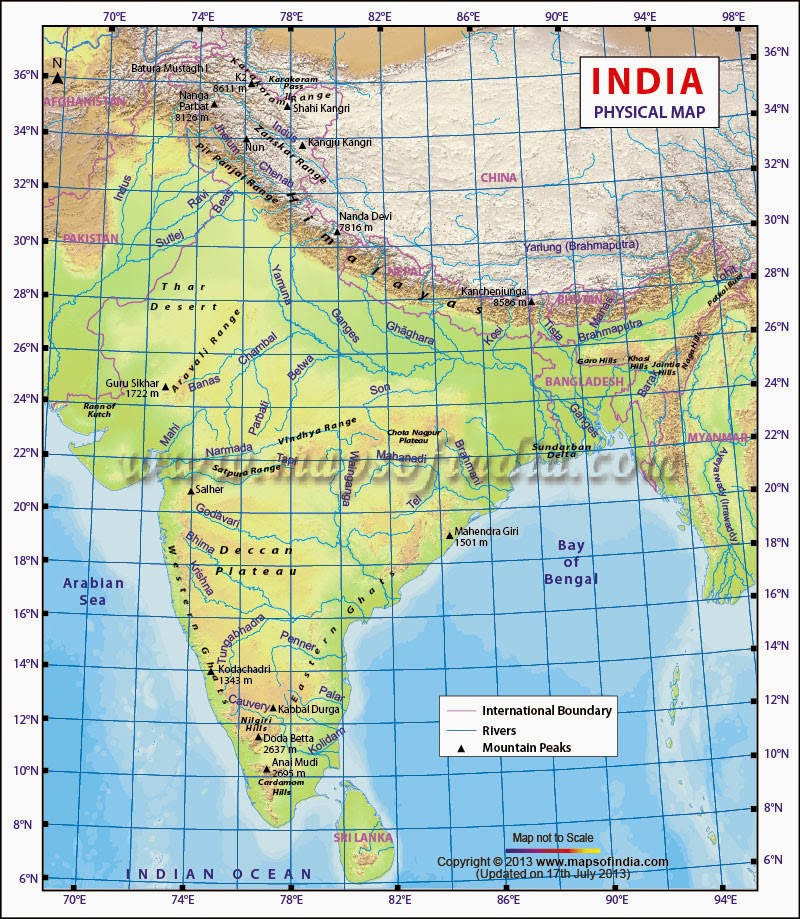
Currently, India is part of South Asia. The northern frontiers of India are defined largely by the Himalayan mountain range, where the country borders China, Bhutan, and Nepal. Its western border with Pakistan lies in the Punjab Plain and the Thar Desert. In the far northeast, the Chin Hills and Kachin Hills, deeply forested mountainous regions, separate India from Burma. On the east, its border with Bangladesh is largely defined by the Khasi Hills and Mizo Hills, and the watershed region of the Indo-Gangetic Plain.


India Physical Map 

lets take up border disputes and their related issues country wise.

India & China

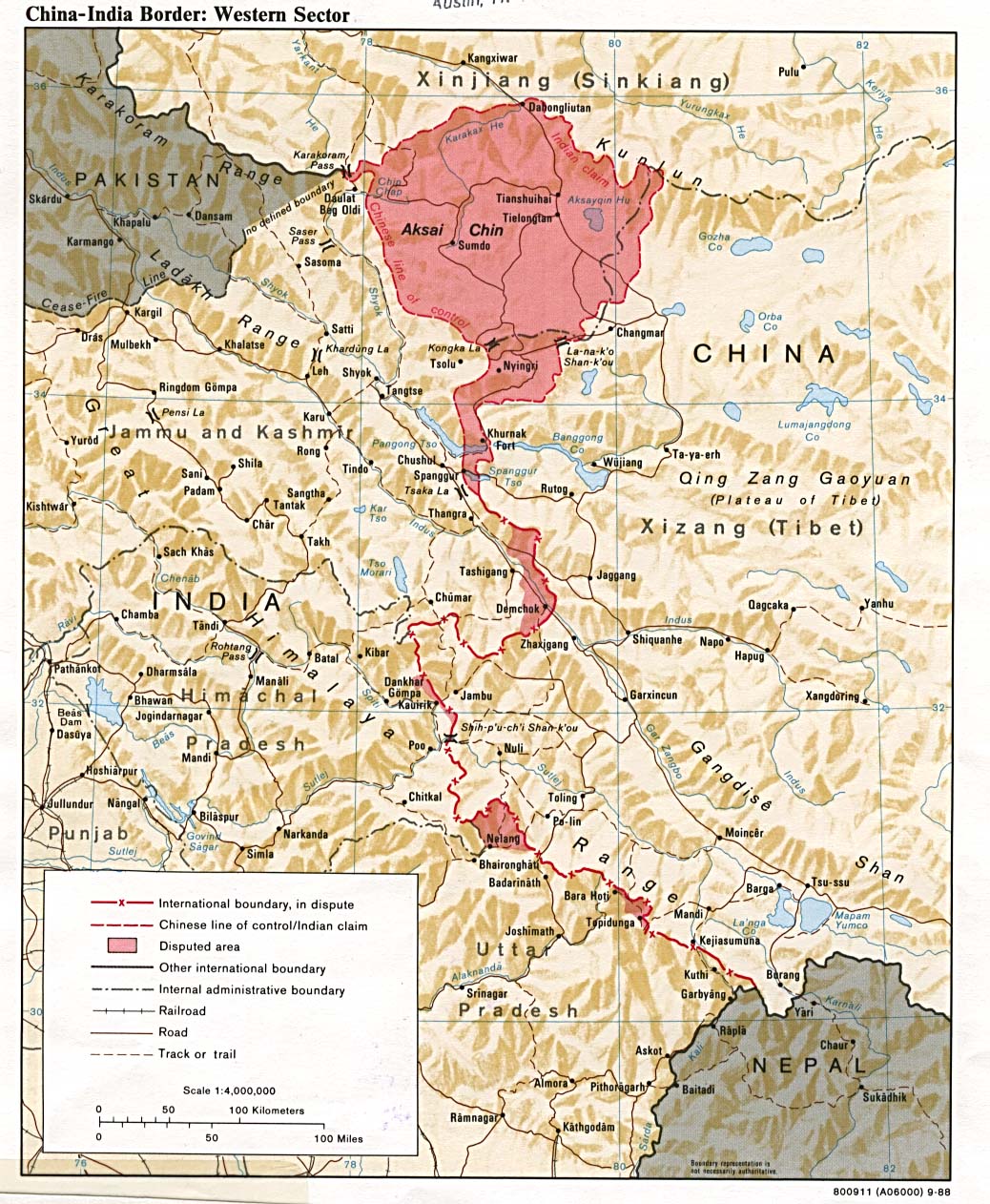
India- China Western Border and disputed area

 
The boundary issue between India and China are mainly because of two areas. One lies in the north eastern part of former princely state of Kashmir. It is now either in Indian province of Kashmir or in Xinjiang province of China. It is uninhabited wasteland crossed by Xinjiang-Tibet highway. The other boundary in dispute is between Arunachal Pradesh of India and South of Tibet.It is sparsely inhabited with numerous local tribes.

Understanding Aksai Chin dispute

Aksai Chin is North-Eastern part of Kashmir. Sikh confederacy of Punjab had annexed Ladhakh into state of Kashmir in 1934. In 1941 they invaded Tibet, Chinese forces defeated and inturn entered Ladhakh and besieged Leh. After being checked by Sikh forces Chinese and Sikh forces signed an a treaty in 1842, which stipulated no transgressions or interference in the other countries frontiers. After british victory over Sikhs, the British have attempted to meet with Chinese officials to discuss the border. However, both sides were sufficently satisfied that traditional border was recognised and defined and border was never demarcated. the boundaries at the two extremeties, Pangong Lake and karakoram pass were well defined but the Aksai Chin area lay undefined.   

The Johnson Line

W.H. Johnson, a civil servant with survey of India proposed the "Johnson Line" in 1865, which put Aksai Chin area in Kashmir. During this time Aksai chin was bordering Turkestan and hence Chinese were never presented this boundary line. Later Chinese reconquered Turkestan. British had doubts about this line and has been censured. In 1897 a British Military officer, Sir John Ardagh argued that this line was more defensible and later this line came to be known as "Johnson-Ardagh line".

The Macartney-Macdonald Line

In 1890 British and China were allies angainst Russian threat to Aksai chin. Chinese showed interest in Aksai Chin and Britain proposed revised boundary suggested by George Macartney which put most of the Aksai Chin in Chinese territory. The British presented this line to Chinese in a note by Sir Claude Macdonald. The Chinese never ratified this and British took this as Chinese acquiescence. This line is knows as "Macartney-Macdonald line", its approximately along Line of Actual Control.
Both The lines were used in British maps of India later.

Since 1947

Upon independence in 1947, the government of India used the Johnson line as the basis for official boundary in the west. The Chinese argued that the western border has never been delimited, that the Macartney-Macdonald line is the only line which was ever proposed to Chinese government. Chinese government also argues that Aksai Chin is already under the Chinese Jurisdiction, and the negotiations should take into account the status quo. During 1950s, Chinese Government built a road connecting Xinjiang and Western Tibet, which runs 179 km south of Johnson line.
the Indian position, as stated by Prime Minister Jawaharlal Nehru, was that the Aksai Chin was "part of the ladhak region for centuries" and this border is "firm and definite one which was not open to discussion with anybody"

Trans Karakoram Tract

The Johnson line was not used to the west of Karakoram tract, where Pakistan-administered Gilgit-Balistan. In 1962, China and Pakistan began negotiations over boundary in the west of Karakoram pass. In 1963 they settled the boundary largely on the basis of Macartney-Macdonald line. This agreement provides renegotiation in case of settlement of Kashmir dispute. India does not recognise Pakistan and China have a common border. However, India's claim line in that area does not extend as north as Johnson line beyond karakoram tract.

The McMohan Line

India-China Eastern border
British India and China gained a common border after British annexation of Assam in 1826 and also after Anglo-Burmese war(1824-1826).
In 1914, Offical representatives from Britain, tibet and China met in Shimla and drew up an agreement regarding Tibet's borders. the Macmohan line which demarcates boundary between India and Tibet in eastern sector was drawn by Henry Macmohan on a map attached to the agreement. China immediately repudiated the agreement, objecting Sino-Tibetian boundary. A treaty was signed without consent of China, stating that China could not enjoy full rights if it does not ratify the treaty.
British wary of legal status of the accord, never put McMohan line on Maps until 1937, nor did they publish the Sila Convention in the treaty record until 1938. China argues that the Shimla Agreement is illegeal, rejecting Tibetian delcaration of Independence and stating that the agreement was between the local government of Tibet without treaty making powers and British.
Governer of Assam in 1938 declared that Tawang was undoubtedly British, which was administered by Tibet. During World War II, with the threat of Japanese invasion and Chinese expansionism, British took control of Tawang for extra defence.
China claims area south of McMohan line based on the traditional Chinese imperial boundaries and India claims the area based on British imperial boundaries. India claims that the Chinese boundaries are not recognised by any other country.
Some of the areas under indian claim lie East of McMohan line, India argues that intent of the treaty was to follow that Highest ridges of Himalayas. So, south of the highest ridges should be Indian territory and North to be Chinese territory. In Indian claim, the two armies will be divided by highest mountains in the world. In 1950s India modified McMohan line based on this and annexed Thag La, Logju and Khinzemane. India's claim moves India-China-Bhutan trijuction to 27°48'N as opposed to McMohan line's 27°44'33" N.

Recent Developments

please refer to this article by http://www.stratfor.com/the-hub/himalayan-flux-recent-developments-india-china-border-dispute 

You can also refer to my upcoming blog. 


Saturday, October 12, 2013

Yellow brick road to "Success": A step by step approach to UPSC India, Civil Sevices, Part-II

In the previous post, "Yellow brick road to "Success": A step by step approach to UPSC India, Civil Sevices, Part-I", we focus mainly on how to jump start your preparation for Civil Services Examination. We also covered, how to choose an optional subject, do we need coaching or not and a few other things.

In this part I'm going to focus on Physical and Psychological conditions that  are optimal for maintaining the zeal to prepare in the long run. We will also cover some of the books, magazines and news papers relevant for the preparation. 

First, I'm pretty sure most of you have a problem with reading and studying for long hours and some of you have problem in maintaining the interest for months and in some cases years while preparing. I know that most of you will agree with me when I say, maintaining sound mind and body is very important for achieving success in any field. I have some simple techniques you can follow to make your life easier while preparing.

How do I maintain myself?

During preparation there will be fluctuations in level of enthusiasm, maintaining sound body and mind is the key. some of the things are listed out here.
  • Take care of your health, eat well and exercise regularly.
  • Maintain positive attitude, even in your lowest time remember that it's just a phase you are passing. You will get civil services if you work hard.
  • If you want to become a civil servant start feeling like one. Eat, think, sleep, walk and do everything like one. Take part in the academic discussions, keep your eyes and ears open for every important thing happening.
  • Don't try to fill the hours, try to utilize the time you have. Most often people who are preparing tend to sit for long hours, after a certain point sitting like this gives diminishing returns. For this, plan the day as if you are doing a job, 8-9 hours compact yet comprehensive plan.
  • Write at least 400-500 words everyday.  Write the gist of everything you have learnt on that day. It helps you remember, recapitulate and improving writing skills.
  • Maintain a schedule, this is the hardest task people face. Normally without a schedule, indiscipline tends to creep in. Schedule is the key to self-discipline. 
  • Take an outing once in a while. Breaks help in rejuvenating your energy.
These are the basic points you need to follow to keep yourself fit. Now lets talk about books, NEWS papers and magazines important for preparation. As I said earlier, keeping your eyes and ears open for important things happening, is a very important task. For this you need to know some of the basic yet important sources.
 
Here is a list of books subject wise:
Read NCERT books for basic understanding about anything.

Topic Wise Reference On General Studies

Books on Indian History & Culture:
NCERT (+ 2 level) — Ancient India, Medieval India, Modern India.
Publication Division : Gazetteer of India (Vol 2 : History & Culture)
Gandhi Nehru Tagore & Ambedkar — Gopal Krishna
Bipin Chandra - Modern India
A.C.Banerjee - History of Modern India 

Raghavan Aiyer — Mahatma Gandhi
IGNOU Text books- Indian culture and Heritage

Books on Geography:
NCERT : Physical Geography of India for X - XII Std
NATMO atlas, this is a Government printed atlas.
Sharma & Cotinho : Economic and Commercial Geography of India.
Khullar : India- A Comprehnsive Geography
Charles Farro : General Principles of World Geography
Charles Farro : Monsoon Asia Reports published by Centre for Science and Enviornment And Tata Energy Research Institute
National journal - Kurukshetra, Yojana etc.
Down to earth

Books on Indian Economy:
NCERT (+1 level)—Evolution of Indian Economy(I C Dhingra).
Mishra & Puri or Dutt & Sundaram - Indian Economy
Economic Survey
The Economic Times,Business Standard
Yojana Magazine

Books on Social and National Issues :
Social Problem - Ram Ahuja
Social Welfare Magazine - Published by ministry of social welfare
Yojana/Kurukshetra
IIPa Journal

Books on Indian Polity:
NCERT (+1 level)—Indian Political System
N.L. Madan : Bhartiya Rajya Vyavastha
D.D. Basu—Indian Constitution
Kashyap—Constitution of India
Publication Division—Subhash C. Kashyap : Our Parliament
P.M. Bakshi—Indian Constitution
Our Constitution : Subhash C. kashyap
Perspective on Constitution : S.C. Kashyap
Frontline Magazine
IIPa Journal

Books on Science & Technology:
NCERT : (10 level) : Science, (+2 level) : Biology.
Popular Science Series (CSIR)
Reports Of the Ministry of Science and Technology Yojana
Science Reporter
Science and Technology in India - Spectrum


Books on India and the World :
Journal of peace Studies
World Focus
Strategic Analysis
South Asian Journal

Other Books for General Studies:
1. India Year Book latest
2. EPW (Economic and Political Weekly), Outlook and Frontline
3. Guides like Tata Mc Graw Hill, Spectrum or Unique For General Reference 4. The Pearson General Studies Manual


With this I conclude this part. In the next part I'm going to write about Indian culture and heritage. Hope this post helped you.


Monday, October 7, 2013

Yellow brick road to "Success": A step by step approach to UPSC India, Civil Sevices, Part-I

Everyone says that preparing for civil services is laborious. Traditionally, since the time civil services was started by Lord Cornwallis in 1853, everyone believed and still believes that hard work is key to success in Administrative Services examinations for IAS, IPS, IRS etc. I tend to deviate from the tradition, I believe that a perfect blend of hard work, smart work (sometimes both of these are not too different) and quick wit (presence of mind) is the key. However,  it is easier to preach than to follow. Throughout this year, I'll show how I came up with that perfect blend and hope you find yours in the due course of time.

I aspired to become an IAS officer, after witnessing the actions of then collector of my district, Sumita Dawra (Author of book "Poor but Spirited in Karimnagar"). She came to my school for Republic Day, saw an under-aged child working for mic setup, and immediately took action against the owner. Then she went on to implement strict laws against child labour in the district. Her actions, triggered a mixture of emotions in me. The humanitarian vigor, sense of justice, quest for betterment and overall the power she wielded to implement the right thing, made me aspire a future in administration.

So at the onset of my research,  I was riddled with a lot of questions after understanding, how UPSC conducts it, what the syllabus is, how long does it take and a lot of other things.  Questions like, "Where should I start?" "What is the pattern?" "What are the books?" "What should be my optional?" "Is the optional I took right for me?"  "Why are the questions in the exams different from what we are taught in coaching centres? ""What attitude should i maintain?". I'm pretty sure that a lot of UPSC exams related websites will give you a lot of answers to these questions. Here I'm going to add a little bit more.

First question I'm going to take up is "Where should I start?" 

Start by understanding the time it takes for an average person to prepare for the exam. It is normally 1-2 years. Then decide the year of your examination. That is the first step. Then choose your optional, this is first hurdle in your path. I would like to caution you about the people who suggest you to opt for "scoring subjects", do not follow the herd. Remember that even though a certain subject is mark fetching for a lot, that does not mean it will fetch marks to you too and do not forget that you have to master that subject and it takes hours of work, understanding and interest towards it. My suggestion would be, start with reading NCERT text books of class IX, X, XI, XII classes, of all the subjects which are your probable optionals. Subjects like, History, Geography, Economics, Political Science, Sociology and Psychology. If you can't understand the NCERT books of XI and XII of a particular subject, that is definitely not an option for you. If you don't understand any of the subjects, choose the one you understand, and enjoy reading the most.This process normally takes almost a month for a person. Even if you are decided on your optional, I suggest you to read these books, because comprehensive knowledge of all these subjects is a must for Civil Services exam. 

Next comes, Deciding if you need coaching or not. The answer to this question is biased in almost all the websites. The websites tend to prefer coaching. Though I joined a coaching centre, I do not say it is a necessary condition, there are a lot of success stories of people who have not gone coaching centres. My favourite teacher in school, Mr. Shareesh kumar, who is in service now, never took coaching, and another interesting thing about him is, he never took same set of optionals twice in his four attempts. So, neither taking coaching nor sticking to same optional is necessary. People who are working, or people cannot afford them need not feel left out. If you have right attitude and an infallible plan, you are at a good start. 

Now for people who want to go to coaching centre.  There are a lot of renowned institutes around, though they are famous that does not imply that they are best for you. Deciding the suitable Coaching centre for you depends on a few things and remember choosing a wrong one can demotivate certain people. The checkpoints for deciding are:
  •  Is the pace of course right for you?
  • Is the peer group comfortable?
  • Is the coaching centre well established and organised?
  • Is the fees in your budget?
There are some low impact checkpoints too, which vary from person to person.
I'm going to give some basic information about coaching fees, cost of living in renowned areas for good coaching centres, like Rajendra Nagar and Mukherjee nagar in Delhi. Normally Institutes charge 75k-1 Lakh for GS Mains+ CSAT for 4-6 months. Optional is charged around 30-40k for 3-4 months. Cost of living in Mukherjee Nagar is 12k and Rajendra Nagar is 15k. One can squeeze it a little if they are ready to travel to get to coaching centres.

With this I conclude first part of the journey, hope you find the information and suggestions informative. In next part I'm going to talk about the physical and psychological conditions good for maintaining the zeal in the long run, and some of the books, magazines and news papers relevant for the preparation.